

Introduction to Sacred Geometry & the Tarot: Journey of the Fool
Written by Kevin J McKee for the SoJournal and Personal Guide 2026. Reprinted with permission.
Our universe is made up of cycles within cycles, constantly moving, expanding and contracting. From our human perspective they can seem impossible to decipher, so we observe and analyse, create interpretations, agreements and mythologies to explain the unexplainable. Some of these being fanciful and some more “scientific” and logical.
Sacred Geometry and the Tarot are two methods of sharing the human experience and interpreting these cycles in an objective way that makes sense and can be understood and interpreted by most people.
Sacred Geometry: The Science of Number in Space
Sacred Geometry is part of the Quadvarium studied in classical “liberal arts” education, historically between Plato’s time and the Middle Ages, that were considered essential to be considered educated or civilised.
The Quadvarium was the second level of education after the Trivium (grammar, logic and rhetoric) and consisted of four subjects: arithmetic, geometry, music and astronomy.
Over time the mystical and scientific aspects of the human experience became separated and the Quadvarium subjects changed a little to focus only on the more “esoteric” aspects of the discipline. They focus on the energy and movement of numbers, each one expanding dimensionally:
- Numerology: The study of number itself – the energy of each number (1 – 9, we include 0 as well).
- Sacred Geometry: The study of number in two-dimensional (flat) space – how the energy of numbers can be used to create sacred space.
- Harmonics: The study of number in time – how the energy of numbers move in time, and can be used in music to heal, shift emotions etc.
- Astronomy: The study of number in space and time – how the energy of number presents and behaves in three-dimensional space.
In our discussions of Sacred Geometry, we will also discuss the basic energies of number that form the basis of numerology that supports the shapes discussed in Sacred Geometry.
To practice Sacred Geometry all you need is some clean, white unlined paper, a compass, a straight edge and a pen (not a pencil).

The Tarot Deck
The tarot deck has been around for centuries and has many origin stories some more mythological, and some more factual.
My favourite of the more esoteric versions is that the cards were created to preserve the knowledge and wisdom contained in the Library of Alexander before it was destroyed. The information was “coded” into images and hidden in a gambling game. Apparently, the scholars knew, that while humanities search for wisdom might die, its thirst for quick gain and its lower nature would never disappear.
Another myth is that Thoth, the god of knowledge and higher understanding gave 22 images illustrating great wisdom to the ancient mystery schools of Egypt. The initiates would be lead between pillars showing these images and have the meanings explained, then go through an underground passageway to the Great Pyramid where the meanings and deep wisdom would be explained in more depth.
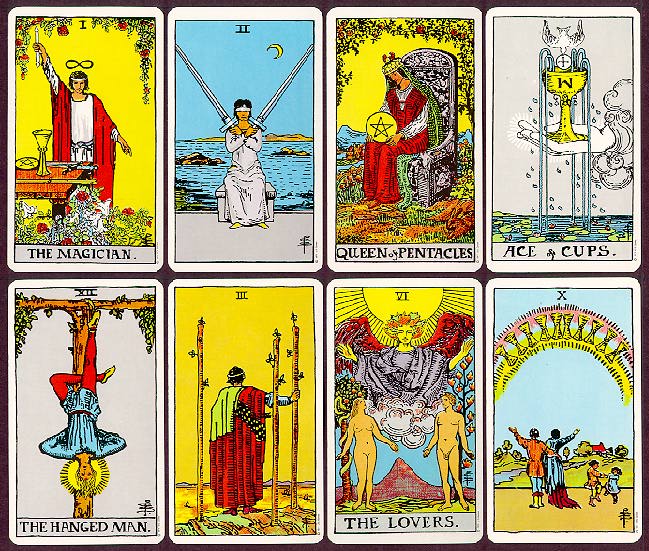
Neither of the above have any archaeological evidence to support them, but they do make sense in a way.
The factual mentions I have been able to find in my research are as follows:
- The first mention of the Tarot was in 1332 by Alphonse XI, King of Leon and Castile. He banned them along with other gambling games.
- In 1337, Johannes, a German monk, wrote that they “could be used to teach morality”.
- In 1392, Charles VI of France bought three sets of the Major Arcana from a man named Grigonneur.
- By the 1400’s, the Italian version, known as the Tarocchino, had over 100 cards including the Zodiac and the so-called Christian Virtues.
Every myth has an element of truth, and each truth has an element of myth to it, so I will leave it up to you what to believe or not.
One thing that is true for me though, is that the cards do seem to contain deeper meanings and understandings about the human condition and processes. Particularly when you study the cards as we will be doing, in the form of a journey, The Journey of the Fool (Everyman).
The Journey of the Fool is useful for understanding how the process of life works, how we grow and assimilate information, and deeper contemplations on our human experience.
There are many versions of the Tarot available these days and I am often asked which is the most accurate, or true. The only honest answer I can give is “I don’t know, decide for yourself which you connect to”. The Rider-Waite deck is generally considered the “purest” version and is often used for teaching the Tarot. In my experience, they do seem to include the most depth of meaning for me.
It is important to note that there is a difference between tarot cards and oracle cards. The Tarot deck has a specific structure and consistency of symbology, I have noticed that different versions may highlight some aspects of the cards above others, though.
Oracle cards can be almost anything, from angel cards to rune cards and everything in between. They can be 5 cards, or 300 cards, depending on their purpose and anticipated use.
In my readings I use a combination of both tarot and oracle cards, see what works for you.
Monthly articles
Each month we will look at one of the numbers and its appearance, meanings and behaviour in two-dimensional space, and one of the Tarot cards in the Major Arcana of the traditional tarot starting with the Blank Page (0) and The Fool, both zero points of their respective disciplines.
A good time to read/re-read the introductory two articles would be on 31 December 2025 as close to midnight as you can. If you stay up for New Year celebrations, then any time before midnight. Maybe use them as part of a meditation looking back at 2025, accepting and forgiving yourself for your “mistakes”, and making choices for moving forward into 2026.
Each month you can use the shape/number and tarot card in contemplation on the first of the month, or during the month if you prefer. It is your journey, and you get to choose how to walk it.
Quick tip: If you find yourself resisting a particular card, number or shape, it could be because your ego doesn’t want to face something, or it represents something that frightens you or triggers you. That’s ok, do the best you can but try not to skip it totally. You cannot heal what you can’t see, so let the fear motivate you to heal aspects of yourself you are afraid of instead of letting them control you.
Society in general seems to want everything immediately, we have lost the sense of process and progression. Life is a process and so is Sacred Geometry and the Tarot, use each article without skipping or jumping ahead, let the knowledge mature during the month so you can fully embrace it.
Basic meditation
Below follows a basic meditation you can use to connect to and contemplate the numbers and shapes discussed in the Sacred Geometry articles, and the Tarot card discussed each month.
Read through the instructions below, don’t be scared to open your eyes and check something rather than hope you are doing it right. The answer to the questions; “Am I doing this right?” and “Am I meditating?” is always no. If you are thinking, you are not meditating. Meditation is a heart-based process, not an intellectual one.
Trust yourself just a little bit, you can do this. Everyone meditates in their own way, don’t panic, do the best you can right now and surrender to the process.
- Prepare as you normally would for meditation if you are an experienced meditator. If you haven’t meditated for a while, or ever, use a place you can be undisturbed, maybe light a candle (white would be good for this purpose), light your favourite incense, put on some instrumental music, lyrics will disturb your concentration. Sit comfortably on the floor or on a chair, wear loose clothing or at least loosen belts etc.
- Take a few slow, deep breaths focussing on relaxing, releasing the thoughts in your head, your mind will start running around a bit, that’s ok, acknowledge the thought, let it go and focus back on your breathing. Meditation is an exercise and like any exercise it takes a bit of practice to “get it right”.
- An important thing to remember about meditation is that it takes place in the inner planes of your mind, so release your expectations of what is going to happen, release your expectations about what is correct or right and relax into the process.
- If you try to control the meditation you are not meditating, you are just breathing deeply. Be open to receive, even if what you receive is not what you expect or hope for.
- If your attention “skips”, that’s ok, take another deep breath and focus again. It will get easier with practice.
- If you have already done a meditation to create a meditation temple or inner temple etc. you can use it for this process, if you haven’t created an inner temple or something similar, you can imagine your mind and awareness moving down from your head into your heart (PS – apparently your physical heart has brain cells in it too – called the heart brain – more about the heart space in the article on (0) or the blank page).
- Spend some time focussing on the symbol or card, no judgements, no expectations, just relax and allow thoughts to flow toward you, not from you. If you get distracted, that’s ok, take a breath and focus again.
- When you feel you have absorbed everything you can for the moment, focus again on your breathing, you may feel disconnected from your body, that’s normal, take some more breathes focussing on balancing your mind with your body, rub your fingers and thumb on both hands together until you feel centred, calm and grounded.
- Take a massive breath in, blow yourself up like a balloon, then exhale in a rush allowing all the air to rush out of your lungs, then breathe normally and when you feel ready open your eyes.
Tip: Maybe before you start the meditation itself, practice the steps a few times until they become comfortable. At step 4 where you would normally focus on the symbol or card, focus on maintaining the stillness and peace of the heart space. Practice makes perfect, commit yourself to 20 minutes a day to do this.
A few notes on meditation
- It is your experience, trust yourself and your intuition.
- You may or may not have similar experiences to others, don’t compare
- Deep breathing and relaxed focus are key. If you are thinking, you are not meditating, relax and go with it.